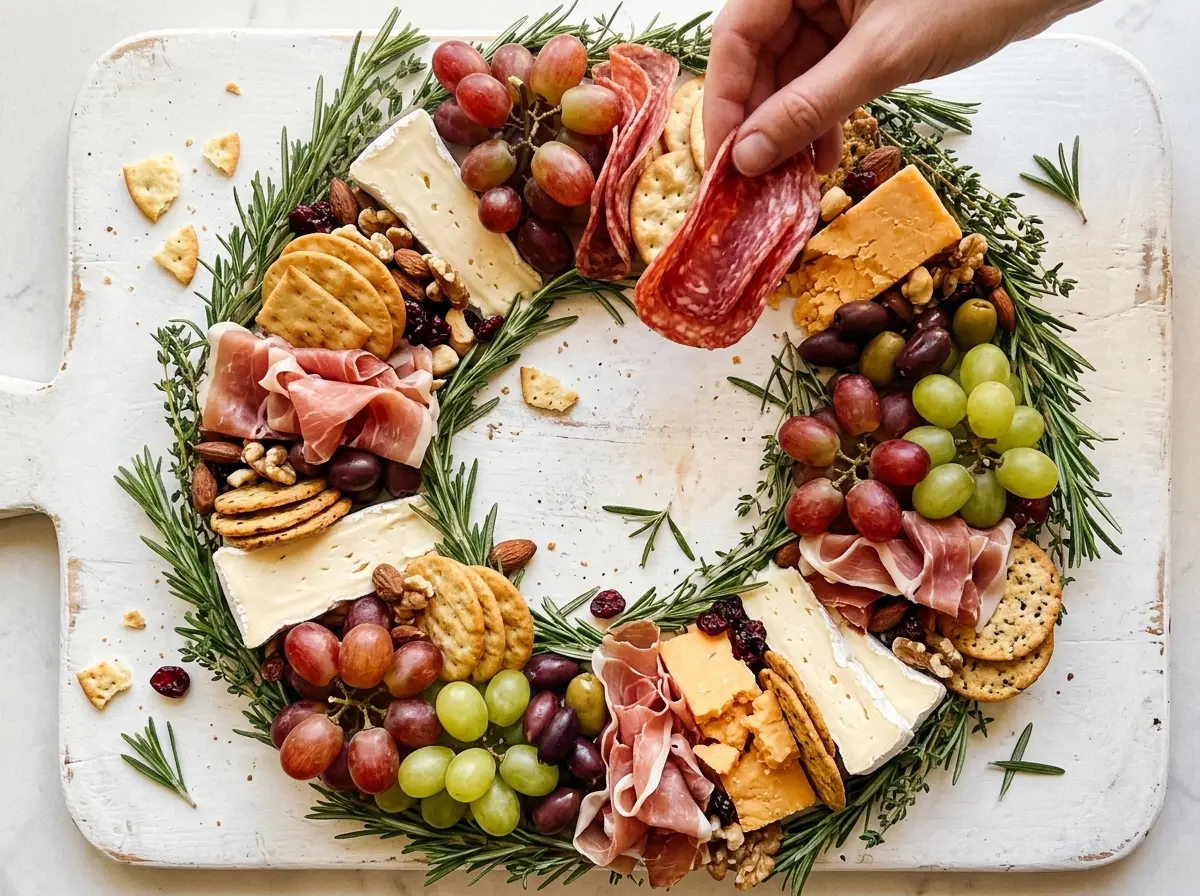
The rosemary sprigs make the first circle, but a bare 14-inch platter can look unfinished until the other pieces begin to fill the ring. Once the salami and cheese clusters are in place, little bunches of fruit make the shape read clearly. This Charcuterie Wreath is a no-cook centerpiece for eight, and it solves a familiar party-table problem: guests can spot what they want without sorting through a crowded board.
I like how the wreath balances savory bites with sweet and crisp ones, while the open center keeps the arrangement from feeling packed edge to edge. The ingredients stay recognizable, so each person can choose a combination that suits them. Fresh rosemary gives the platter its seasonal look, and the crackers make it easy to turn the display into a ready-to-eat spread.
Kitchen Note
Keep the rosemary in a low layer instead of piling the sprigs into a thick rope. That leaves more room for the food and gives the wreath a clean green outline.
Save this Charcuterie Wreath for a no-cook centerpiece with savory folds, sweet fruit, and a crisp cracker border.
Why an Even Scatter Makes This Wreath Harder to Eat
It’s natural to want to distribute every color evenly, but a wreath made from tiny, scattered pieces looks busy and is awkward to serve. Keeping similar foods in small clusters gives the platter a little visual order. Guests can see where the cheese is, where the fruit is, and which bites are briny without having to pick through a mixed pile.
Think of the ring as a series of short sections rather than one perfectly uniform pattern. The cheddar and manchego stay in their own clusters, while the grapes and cherry tomatoes sit in small bunches around the circle. Tuck the smaller items into gaps instead of spreading them over the larger pieces. That preserves the open center and lets each ingredient keep its own color and texture.
The same approach helps when someone reaches in for a bite. A distinct cluster is easier to lift from the platter than scattered pieces pressed against one another. You don’t need exact spacing or a mirrored arrangement; a few visible groupings are enough to make the wreath feel intentional.
What Each Ingredient Brings to the Wreath

- Fresh rosemary — The sprigs form the green outline and bring a fresh herbal scent to the platter. Fresh, flexible sprigs are easier to arrange than brittle ones; dried rosemary won’t make the same visible ring. If you leave it out, the arrangement loses its wreath-like frame.
- Thinly sliced salami — Thin slices fold neatly into small clusters, adding a savory, cured-meat bite without taking up much room. Choose slices that bend without tearing; thick pieces won’t make the same tidy folds. Nothing else on this ingredient list has quite the same savory character.
- Cheddar and manchego — Cheddar gives you a familiar, firm cheese, while manchego brings a distinct nutty taste and a different look. Cut both into even 3/4-inch cubes so they’re easy to pick up. If you want a milder, more familiar arrangement, use cheddar in place of the manchego cluster; you’ll lose some of that nutty contrast.
- Green grapes and cherry tomatoes — Grapes bring juicy sweetness, while tomatoes add a fresh, tart bite and a pop of red. Rinse and dry both well so they don’t leave moisture on the platter. Firm fruit holds its shape better than soft or split grapes and tomatoes.
- Olives and cornichons — These briny bites cut through the richer cheese and salami. Pitted olives are easiest to serve, and draining both items keeps excess brine from pooling among the other ingredients. Cornichons are small enough to tuck into open spaces without dominating a section.
- Dried apricots and roasted almonds — Apricots add a chewy, sweet bite; almonds bring a crisp, toasted contrast. Roasted almonds are ready to serve as they are, and dried apricots should be soft enough to bite without pulling apart the arrangement.
- Assorted crackers — A mix gives guests different shapes and textures to pair with the toppings. Choose crackers sturdy enough to hold a cheese cube or a folded slice of salami; delicate ones are more likely to crack when picked up.
Building the Wreath Without Losing Its Shape
Lay Down the Rosemary Circle
Arrange the 6 to 8 fresh rosemary sprigs in an overlapping circle on a 14-inch round platter. Leave a clear open space in the center so the arrangement reads as a wreath instead of a solid bed of greenery. Keep the outline broad enough to give the food room around the ring. If the sprigs form a thick mound, spread them into a lower layer before adding anything else.
Fold the Salami and Set the Cheese Clusters
Fold each thin salami slice into quarters, then tuck the folded pieces into small clusters around the rosemary. The quarter folds should look loose rather than pressed flat. Arrange the cheddar and manchego in separate clusters around the wreath, keeping the two cheeses distinct. Cut the cheese into 3/4-inch cubes so each cluster looks consistent and is easy to serve.
Fill the Ring with Fruit and Briny Bites
Add small bunches of grapes and cherry tomatoes around the wreath. Let those colorful sections sit between the salami and cheese clusters rather than hiding them. Tuck the olives, cornichons, dried apricots, and almonds into the open spaces. If a small item rolls toward the center, move it back into a gap along the ring.
Finish with the Crackers
Arrange the assorted crackers around the outside of the wreath, where they’re easy to reach without covering the other ingredients. Give them a little breathing room so guests can lift one without knocking into a neighboring cluster. Serve the assembled wreath within 2 hours. The platter is ready when the circle is easy to recognize and each type of bite has a visible place.
Simple Ways to Adapt This Charcuterie Wreath
Make It Meat-Free with Cheese Clusters
Leave out the salami and use the cheddar and manchego clusters to fill more of the ring. The result is a meat-free, cheese-and-produce-forward platter with less of the cured, savory bite and more emphasis on the cheeses.
Make a Milder Wreath
Leave out the olives and cornichons if you want fewer briny bites. The cheese, fruit, salami, apricots, and almonds will still give the platter plenty of variety, but you’ll lose some of the sharp, salty contrast.
Turn It into a Grazing Board
Arrange the same ingredients in separate rows or broad sections on a serving board instead of forming a circle. You’ll lose the wreath silhouette, but the clear sections make it easy to serve when you’d rather have a straightforward grazing-board layout.
Make-Ahead and Leftover Storage
- Refrigerator: Refrigerate leftover cheese, salami, and produce in covered containers and use within 3 days. Keep any crisp leftover crackers in a separate container; they soften when stored beside moist ingredients.
- Freezer: Freezing isn’t a good fit for this platter. The grapes and tomatoes become soft after thawing, and the cheese loses its firm texture.
- Serving: This is served cold, so reheating isn’t needed. Arrange crackers just before serving if you’re preparing the other components ahead.
Questions That Come Up When Making a Charcuterie Wreath
Charcuterie Wreath
Ingredients
Equipment
Method
- Arrange the rosemary sprigs in an overlapping circle on a 14-inch round platter, leaving an open space in the center.
- Fold the salami slices into quarters and tuck them into small clusters around the rosemary circle.
- Arrange the cheddar and manchego in separate clusters around the wreath.
- Add small bunches of grapes and cherry tomatoes around the wreath.
- Tuck the olives, cornichons, dried apricots, and almonds into the open spaces.
- Arrange the crackers around the outside of the wreath.
- Serve within 2 hours.