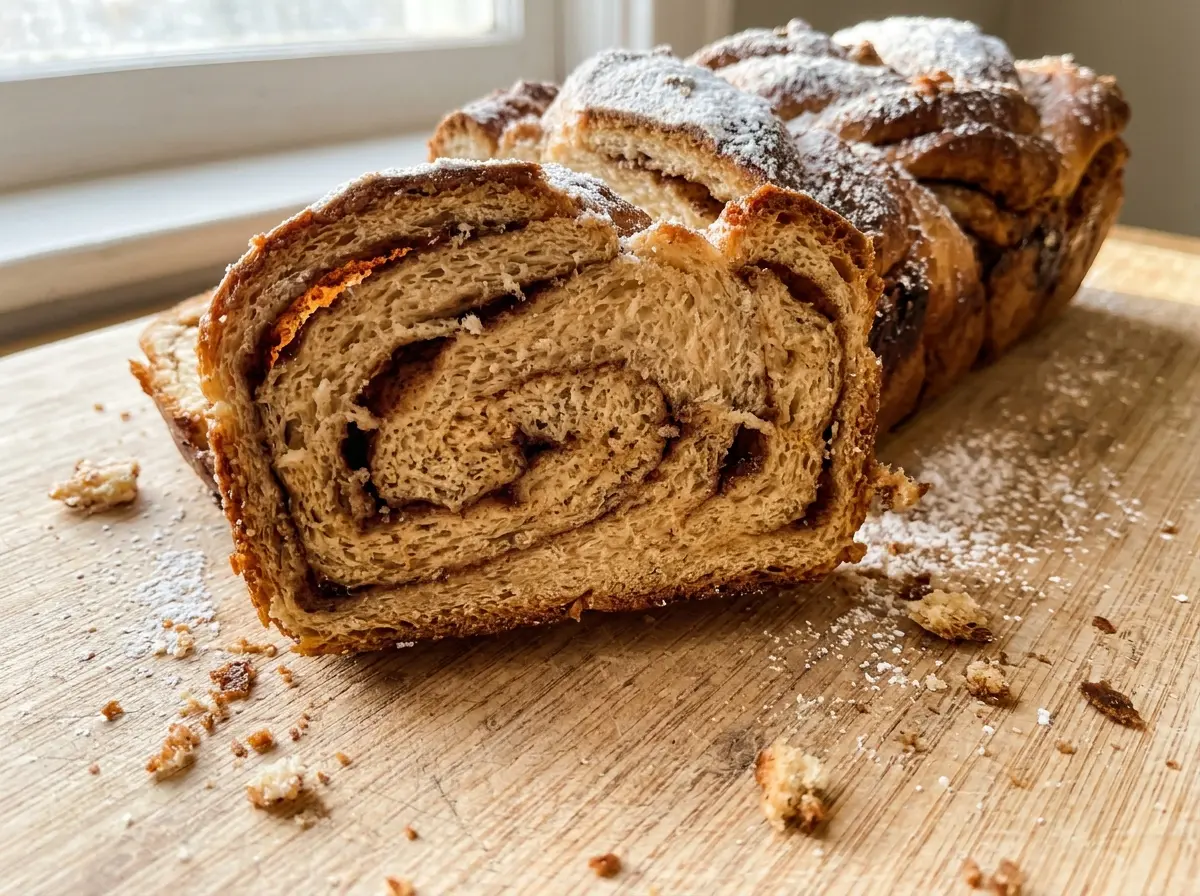
When the rolled dough is cut lengthwise, the cinnamon spiral opens up across both halves. Twisting those halves with the cut sides facing up turns a simple sweet loaf into the kind of bread that looks special before it even reaches the table. Cinnamon Christmas Bread has a soft, buttery dough and a brown sugar filling tucked through every twist.
The dough starts shaggy, then becomes smooth and elastic after a steady knead. Whole milk, egg, and softened butter give it a tender, enriched crumb, while instant yeast keeps the process straightforward. I like that the loaf is shaped on a parchment-lined baking sheet, so there’s room to twist it without squeezing the filling out against the sides of a pan. Once baked, the loaf is golden on top, fragrant with cinnamon, and ready to slice after it cools.
Kitchen Note
Check the milk temperature before it goes into the bowl: it should be between 105°F and 110°F. Milk that’s too hot can damage the yeast, so I use a thermometer instead of guessing by touch.
Save Cinnamon Christmas Bread for its soft, buttery crumb and cinnamon-swirled twist—beautiful on the table and easy to slice once cool.
Why Cutting the Log Makes This Cinnamon Bread Look So Striking
A filled bread can hide its best detail inside the roll. Here, cutting the log lengthwise exposes the cinnamon-sugar layers, and turning those cut sides upward keeps the spiral visible as the halves twist around each other. That’s what gives the finished loaf its defined, braided look rather than a smooth top with the filling hidden underneath.
Keeping the two halves joined at one end gives you an anchor while you twist. If you cut all the way through, the strands are harder to manage and can drift apart as you shape the loaf. Pinching the seam closed before cutting also helps the rolled log hold together, while tucking the ends underneath gives the finished shape a neat outline.
Leave the half-inch border along one long edge when you spread the filling. That uncovered strip is where the log closes; a clean edge is easier to pinch shut than one coated in loose cinnamon sugar. The goal isn’t to make the twist perfectly uniform. A little variation in the crossing strands is what makes the exposed layers look handmade.
What the Dough and Filling Ingredients Bring to the Loaf

- All-purpose flour — Spoon it into the measuring cup and level the top rather than scooping directly from the bag. That keeps the dough from getting packed with extra flour and turning stiff. All-purpose flour gives this loaf a tender, familiar bread texture; whole-wheat flour absorbs differently and makes a heavier loaf, so it isn’t a direct swap.
- Instant yeast — It can be mixed right in with the dry ingredients, which keeps the dough method simple. If you have active dry yeast instead, use the same amount and stir it into the warm milk with a little of the recipe’s granulated sugar; wait until it looks foamy before mixing the dough.
- Whole milk, egg, and butter — Together, these enrich the dough and help give the baked loaf a soft crumb. Fresh, standard grocery-store ingredients work well here; there’s no need for specialty milk or cultured butter. For a dairy-free version, use the specific swaps in the variations below, but keep the egg.
- Light brown sugar — Packed brown sugar gives the filling a soft, slightly moist sweetness that stays nestled in the spiral. Dark brown sugar works in the same quantity for a deeper molasses note, though the cinnamon filling will taste a little richer.
- Ground cinnamon — Since cinnamon is the filling’s main spice, a fresh-smelling jar makes a noticeable difference. If the cinnamon smells faint or dusty when you open it, the finished bread will have a less distinct cinnamon aroma.
From Shaggy Dough to a Defined Cinnamon Twist
Mix and Knead Until the Dough Turns Elastic
Whisk the flour, granulated sugar, instant yeast, and kosher salt together in a large bowl. Add the warm milk, egg, and softened butter, then mix until you have a shaggy dough with no dry patches. Knead by hand on a lightly floured surface for 8–10 minutes; it should become smooth and elastic rather than rough and sticky. If it clings to the work surface, use a light dusting of flour rather than burying the dough in it.
Give the Dough Time to Double
Set the dough in a bowl, cover it, and let it rise at room temperature for 1–1 1/2 hours. Look for a dough that has doubled in size, not just one that has reached the end of the clock. A cool room can slow the rise, so use the change in volume as your cue. The covered bowl keeps the surface from drying while the dough rests.
Roll, Fill, and Twist with the Cut Sides Up
Mix the brown sugar and cinnamon in a small bowl, and line a large baking sheet with parchment paper. Roll the dough into a 10×16-inch rectangle, spread it with softened butter, then scatter the cinnamon sugar evenly while leaving a 1/2-inch border along one long edge. Roll from the opposite long edge into a tight log and pinch the seam closed. Cut the log lengthwise, leaving the halves joined at one end, twist the halves together with the cut sides facing up, and tuck the ends under.
Proof the Shaped Loaf, Then Bake to the Center Temperature
Move the twisted loaf to the prepared baking sheet, cover it loosely, and let it rise for 30–45 minutes, until puffy. Heat the oven to 350°F and bake the loaf for 30–35 minutes, until golden brown and the center registers about 190°F on an instant-read thermometer. The top’s color is a helpful cue, but checking the center tells you the loaf has baked through. Cool it on the baking sheet for 10 minutes, then transfer it to a wire rack and let it cool before slicing.
Two Easy Ways to Adapt the Cinnamon Filling and Dough
Make the Loaf Dairy-Free
Replace the whole milk with the same amount of unsweetened, unflavored oat milk, and use dairy-free baking sticks in place of both portions of butter. Keep the egg in the dough. The loaf will still have a soft enriched texture, with a slightly different flavor depending on the baking sticks you choose.
Use Dark Brown Sugar for a Deeper Filling
Swap dark brown sugar for the light brown sugar, keeping the same amount. Its stronger molasses flavor makes the cinnamon filling taste deeper and a touch less delicate, without changing how you roll or twist the loaf.
Storage and Reheating
- Refrigerator: Skip the refrigerator; it can make the bread stale sooner. Once fully cool, keep the loaf covered at room temperature and enjoy it within 2 days.
- Freezer: The baked loaf freezes well. Wrap it tightly once fully cool, freeze for up to 2 months, and thaw before serving.
- Reheating: Warm individual slices in a toaster, or warm slices in a low oven until heated through. Avoid prolonged microwave heating, which can make bread tough.
Questions That Come Up While Making Cinnamon Christmas Bread
Cinnamon Christmas Bread
Ingredients
Equipment
Method
- In a large bowl, whisk together the flour, granulated sugar, yeast, and salt.
- Add the warm milk, egg, and softened butter, and mix until a shaggy dough forms.
- Knead by hand on a lightly floured surface for 8–10 minutes, until the dough is smooth and elastic.
- Place the dough in a bowl, cover, and let rise at room temperature for 1–1 1/2 hours, until doubled in size.
- In a small bowl, mix the brown sugar and cinnamon.
- Line a large baking sheet with parchment paper.
- Roll the dough into a 10x16-inch rectangle.
- Spread the dough with the softened butter.
- Sprinkle evenly with the cinnamon-sugar mixture, leaving a 1/2-inch border along one long edge.
- Starting at the opposite long edge, roll the dough into a tight log and pinch the seam closed.
- Place it seam-side down and cut it lengthwise in half, leaving the halves joined at one end.
- Twist the halves together with the cut sides facing up and tuck the ends under.
- Transfer the twisted loaf to the prepared baking sheet, cover loosely, and let rise for 30–45 minutes, until puffy.
- Heat the oven to 350°F.
- Bake the bread for 30–35 minutes, until golden brown and the center registers about 190°F on an instant-read thermometer.
- Cool on the baking sheet for 10 minutes.
- Transfer to a wire rack and cool before slicing.