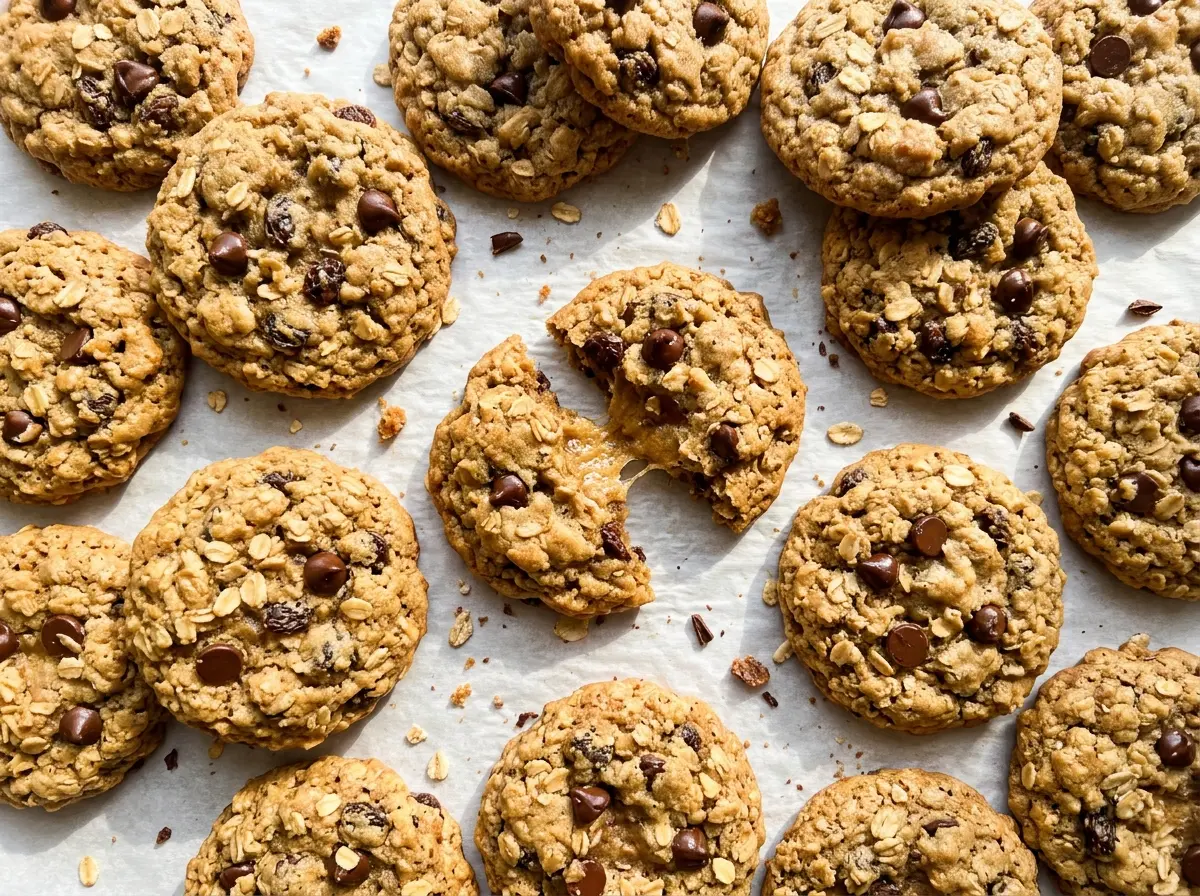
The edges of these cookies turn lightly golden while the centers still look a little soft, and that’s exactly when I take the pan out. They finish setting as they cool, leaving the middle chewy instead of dry. These oatmeal chocolate chip cookies have the familiar cinnamon-and-oat bite, with semisweet chocolate in every cookie.
I chill the dough for 30 minutes before scooping. That short rest lets the oats take up some moisture and firms the butter, so the cookies bake up with a tender chew instead of spreading too quickly. A rounded scoop keeps the portions consistent, and baking one sheet at a time gives the cookies room to brown evenly.
After five minutes on the baking sheet, they’re sturdy enough to move to a rack without losing their soft centers. You’ll get 36 cookies, with crisp, lightly golden edges and a soft oatmeal middle dotted with chocolate.
Kitchen Note
Leave the cookies on the hot baking sheet for the full five minutes before moving them. They’re delicate straight from the oven, and that short pause helps the edges set without drying out the centers.
Save these soft and chewy oatmeal chocolate chip cookies for a bake with tender centers, golden edges, and a quick 30-minute dough chill.
Why a 30-Minute Chill Makes a Better Oatmeal Cookie
Oats are thirsty, and this dough has three cups of them. Giving the mixed dough a short rest lets the oats absorb some of the moisture from the eggs and butter. The dough also firms up in the refrigerator, which makes it easier to portion and helps the cookies hold their shape in the oven.
That balance matters because oatmeal cookies can turn heavy when the oats don’t have enough moisture, or spread into thin, crisp rounds when the dough is too warm. The chill isn’t a long project or a fussy extra step: it’s just 30 minutes, enough time to heat the oven and prepare the baking sheets. Don’t skip it if you want the cookies to bake into a thick, chewy shape.
The other part of the texture comes at the end of baking. Pull the sheet when the edges are lightly golden and set but the centers still look slightly soft. Waiting for the centers to look completely firm in the oven gives them more time to bake on the hot pan, where they’ll continue setting after you take them out.
What Old-Fashioned Oats and Brown Sugar Bring to the Dough

- Old-fashioned rolled oats — These give the cookies their distinct, pleasantly chewy texture. Quick oats break down more in the dough and make a softer, less defined bite, while steel-cut oats are too firm for this short bake. Stick with rolled oats for the texture this batch is designed for.
- Light brown sugar and granulated sugar — Brown sugar brings moisture and a deeper caramel note, while granulated sugar helps the edges bake up lightly crisp. Packed brown sugar gives you a consistent amount; there’s no need to seek out a specialty brand.
- Unsalted butter — Softened butter creams smoothly with the sugars and helps create the dough’s structure. It should give slightly when pressed but shouldn’t look shiny or melted. A standard grocery-store butter works well here.
- Large eggs and vanilla extract — The eggs bind the oats and flour into a cohesive dough, and vanilla rounds out the chocolate and cinnamon. Use large eggs for the intended balance; a good everyday vanilla extract is plenty.
- All-purpose flour, baking soda, cinnamon, and salt — Flour provides the base, baking soda helps the cookies spread and brown, and cinnamon adds warmth without taking over. Whisking these together before mixing them into the butter mixture distributes the baking soda and cinnamon throughout the dough.
- Semisweet chocolate chips — Semisweet chocolate keeps the cookies from becoming overly sweet alongside the brown and granulated sugars. The brand matters less than choosing chips you like eating; they’ll be spread through a cinnamon-scented oat dough either way.
From Creamed Butter to Soft-Centered Cookies
Cream the Butter and Sugars Until Fluffy
Beat the softened butter with both sugars on medium speed for about two minutes. The mixture should look lighter in color and fluffy, not greasy or separated. If the butter is cold, it won’t combine smoothly; if it’s melted, the dough won’t have the same starting structure. Take a moment to scrape the bowl if butter or sugar is clinging to the sides.
Add the Eggs, Then Mix the Dry Ingredients
Beat in the eggs one at a time, letting each blend in before adding the next, then mix in the vanilla. In a separate bowl, whisk together the flour, baking soda, cinnamon, and salt. Add those dry ingredients to the butter mixture and mix only until you no longer see streaks of flour. Mixing beyond that point can make the cookies tougher.
Fold in the Oats and Chocolate, Then Chill
Stir in the rolled oats and semisweet chocolate chips until they’re distributed through the dough. Cover the bowl and refrigerate the dough for 30 minutes. It should feel firmer and less sticky when it’s ready to scoop, but it won’t be hard. While it chills, heat the oven to 350°F and line two large baking sheets with parchment paper.
Scoop Even Portions and Bake One Sheet at a Time
Scoop rounded 1 1/2-tablespoon portions and place them 2 inches apart on the prepared sheets. Work in batches as needed so each cookie has room to spread. Bake one sheet at a time for 10 to 12 minutes; look for lightly golden, set edges and centers that still appear a little soft. If the edges haven’t set, give that sheet another minute and check again.
Let the Cookies Set Before Moving Them
Leave the cookies on the baking sheet for five minutes after baking. They’ll be fragile while hot, so slide a thin spatula underneath only after that brief rest. Transfer them to a wire rack and let them cool completely. The centers firm up as the cookies cool, while the middle stays tender.
Three Ways to Adapt This Batch Without Losing Its Chew
Make a gluten-free batch
Replace the all-purpose flour with the same amount of a 1:1 gluten-free baking flour blend, and use certified gluten-free rolled oats. The cookies will keep their oat-and-chocolate character, though the exact chew can vary with the flour blend; choose one formulated for baking rather than a single gluten-free flour.
Leave out the cinnamon
For a more straightforward brown-sugar-and-chocolate flavor, omit the ground cinnamon and keep the rest of the ingredients and method the same. The cookies will still have their chewy oat texture; they’ll just taste less warmly spiced.
Put a little chocolate on top
For cookies with visible chocolate on their tops, hold back a few of the measured semisweet chocolate chips before stirring the rest into the dough. Press the reserved chips onto the rounded portions just before baking. You’ll keep the same ingredients and get a more chocolate-forward look in each bite.
Storage and Reheating
- Refrigerator: Store cooled cookies in an airtight container for up to 1 week. They’ll feel firmer when cold; let them come to room temperature before serving for a softer bite.
- Freezer: Freeze completely cooled cookies in an airtight freezer-safe container for up to 3 months. Thaw at room temperature before eating.
- Reheating: Warm a cookie in a 300°F oven for 3 to 4 minutes if you want the chocolate soft again. Don’t leave it in long enough to dry out the edges.
Questions That Come Up While Baking These Oatmeal Cookies
Soft and Chewy Oatmeal Chocolate Chip Cookies
Ingredients
Equipment
Method
- Beat the butter, brown sugar, and granulated sugar in a large bowl with an electric mixer on medium speed until light and fluffy, about 2 minutes.
- Beat in the eggs one at a time.
- Mix in the vanilla extract.
- Whisk together the flour, baking soda, cinnamon, and salt in a separate bowl.
- Mix the dry ingredients into the butter mixture just until combined.
- Stir in the oats and chocolate chips.
- Cover the bowl and refrigerate the dough for 30 minutes.
- Heat the oven to 350°F.
- Line two large baking sheets with parchment paper.
- Scoop the dough into rounded 1 1/2-tablespoon portions and place them 2 inches apart on the prepared sheets, working in batches as needed.
- Bake one sheet at a time for 10 to 12 minutes, until the edges are lightly golden and set while the centers still look slightly soft.
- Let the cookies cool on the baking sheet for 5 minutes.
- Transfer the cookies to a wire rack to cool completely.